The post-quantum transition, mapped
Moving off RSA and elliptic curves is a multi-year engineering programme, not a library upgrade. This page maps each step to the package that does the work and to the deadlines that set the pace.
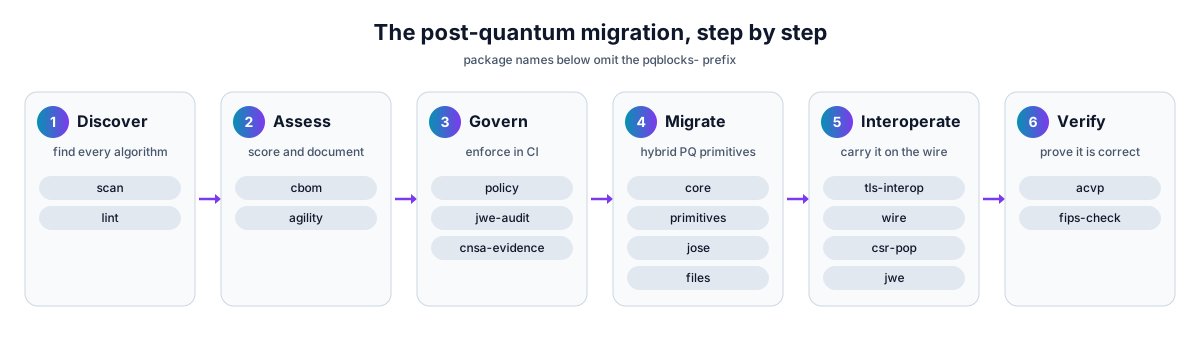
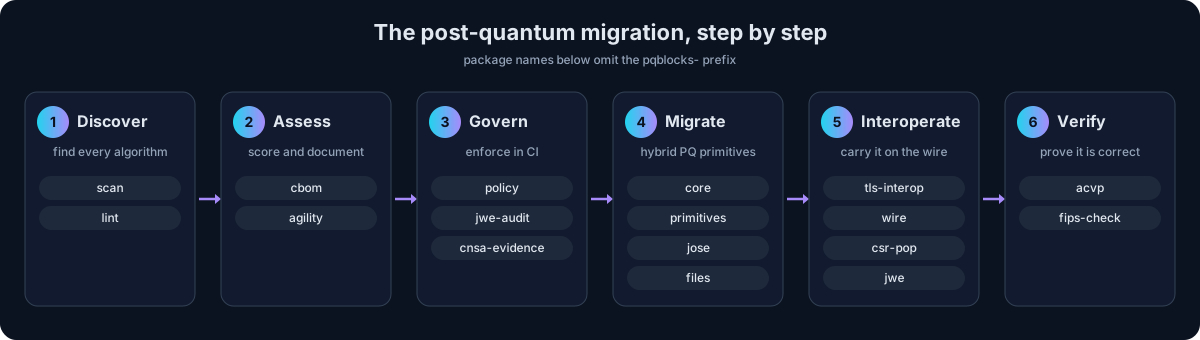
How do the steps connect?
flowchart LR
    subgraph D[1 · Discover]
        A[Source code] -->|pqblocks-scan<br/>pqblocks-lint| B[Inventory]
        T[TLS endpoints] -->|pqblocks-tls-interop| B
    end
    subgraph S[2 · Assess]
        B -->|pqblocks-scan| C[CycloneDX 1.6 CBOM]
        C -->|pqblocks-cbom| C2[Classified CBOM]
        C -->|pqblocks-agility| R[Readiness score]
    end
    subgraph G[3 · Govern]
        C2 -->|pqblocks-policy| P[CI policy gate]
        C2 -->|pqblocks-cnsa-evidence| E[CNSA 2.0 evidence pack]
    end
    subgraph M[4 · Migrate]
        P --> K[pqblocks-primitives<br/>pqblocks-core]
        K --> J[pqblocks-jose<br/>tokens]
        K --> F[pqblocks-files<br/>files]
    end
    subgraph I[5 · Interoperate]
        K --> W[pqblocks-wire<br/>pqblocks-jwe]
        K --> X[pqblocks-csr-pop<br/>certificates]
        K --> L[pqblocks-tls-interop<br/>TLS 1.3]
    end
    subgraph V[6 · Verify]
        K --> AC[pqblocks-acvp<br/>NIST vectors]
        W --> FC[pqblocks-fips-check<br/>boundary checks]
    end
What happens at each step?
| Step | Question it answers | Packages |
|---|---|---|
| 1. Discover | Where do we use RSA, ECC, weak hashes and post-quantum algorithms, in code and on the wire? | scan, lint, tls-interop |
| 2. Assess | How exposed are we, and how hard will the change be? | cbom, agility |
| 3. Govern | How do we stop new classical-only code and prove progress to auditors? | policy, jwe-audit, cnsa-evidence |
| 4. Migrate | What replaces the old primitives in tokens, files and key exchange? | primitives, core, jose, files |
| 5. Interoperate | How do larger keys, ciphertexts and signatures travel through protocols and formats? | tls-interop, wire, jwe, csr-pop |
| 6. Verify | Is the new implementation correct, and did the migration actually land? | acvp, fips-check |
Which deadlines drive the timeline?
| Date | Milestone | Source |
|---|---|---|
| Aug 2024 | ML-KEM, ML-DSA and SLH-DSA published as final standards (FIPS 203, 204, 205) | NIST |
| 2025 | CNSA 2.0: software and firmware signing, web browsers, servers and cloud services should support and prefer CNSA 2.0 algorithms | NSA CNSA 2.0 |
| 2026–2027 | CNSA 2.0: traditional networking equipment (2026) and operating systems (2027) should support and prefer CNSA 2.0 | NSA CNSA 2.0 |
| End of 2026 | EU member states start the transition and complete first inventories | EU coordinated PQC roadmap (2025) |
| 2030 | 112-bit quantum-vulnerable algorithms (for example RSA-2048, P-256) deprecated. CNSA 2.0: software/firmware signing and networking equipment use CNSA 2.0 exclusively. EU: high-risk use cases migrated | NIST IR 8547 (draft), NSA CNSA 2.0, EU roadmap |
| 2033 | CNSA 2.0: browsers, servers, cloud services and operating systems use CNSA 2.0 exclusively | NSA CNSA 2.0 |
| 2035 | All quantum-vulnerable public-key algorithms disallowed; national security systems quantum-resistant | NIST IR 8547 (draft), NSM-10 |
Read the primary sources
Deadlines differ by sector and system type, and drafts change. Plan against the documents themselves: NIST IR 8547, NSA CNSA 2.0 and the FIPS 203, 204 and 205 standards.
Where do I start?
Start with step 1. A complete inventory turns a vague mandate into a list of concrete changes. Follow How to check if my app still uses RSA or ECC, then work through the steps in order.